




MOQ Explained: Custom Gel Motorcycle Cushion Minimum Order Policy
Introduction
1. What Is MOQ for Motorcycle Gel Cushion Manufacturing?
MOQ means the minimum quantity a factory requires to accept your order under specific customization conditions.
For motorcycle gel pads, suppliers separate requirements into three categories:
- Ready stock items (no customization)
- ODM customization (modify existing models, no new molds)
- OEM customization (new mold development, exclusive shape)
Important distinction:
- MOQ per style: Minimum quantity for one size / one material combination
- Total order MOQ: Allows mixing sizes or variants to reach the aggregate quantity target
2. Standard MOQ Tiers for Custom Gel Motorcycle Cushions
2.1 Ready-Made Stock Gel Pads (Zero Customization)
- Typical MOQ: 50–100 pcs
- Customization allowed: None; factory existing colors, fabrics, no logo printing
- Pros: Fast delivery, lowest trial risk
- Cons: Cannot add your brand logo; identical to generic market products
2.2 ODM Customization (Most Popular for New Private Label Brands)
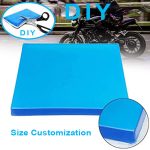
ODM uses the factory’s existing gel core molds. Customization does not require new tooling.
Available changes: brand logo printing, fabric swap, color selection, thickness selection, custom packaging.
- Basic ODM (only logo printing on existing products): 100–200 pcs
- Medium ODM (logo + fabric change + custom packaging): 200–300 pcs
- Mixed-size ODM orders: Most factories allow mixing 25mm /35mm /45mm thicknesses to meet total MOQ
- Special Pantone custom fabric colors
- Multiple logo colors (full-color heat transfer or embroidery)
- Custom printed color boxes
2.3 OEM Customization (New Mold Development, Exclusive Shape)
General OEM MOQ Benchmark: 500–1000 pcs per new mold
Why MOQ is higher:
Factories invest money, labor and machine time for mold design, CNC machining and mold testing. They need larger order volume to allocate production slots and amortize tooling costs.
- Whether MOQ applies per size or can combine multiple sizes under the same mold family
- If repeat orders after the first batch can enjoy reduced MOQ requirements
3. Why Manufacturers Set MOQ for Custom Gel Cushions
- Raw material batch limits
UV-stabilized TPE gel, fabric rolls and adhesive materials are purchased in bulk batches. Small orders create leftover raw material waste.
- Production line setup cost
Switching printing plates, adjusting cutting dies and reconfiguring assembly lines takes hours of labor. Tiny orders cannot cover setup expenses.
- Quality consistency control
Short production runs increase the risk of unstable thickness, uneven printing and poor bonding between gel core and anti-slip base.
- Workshop scheduling efficiency
Factories prioritize stable large orders. Strict MOQ prevents production lines from being occupied by numerous fragmented small custom orders.
4. Practical MOQ Negotiation Strategies
- Combine ODM variants
Mix multiple thicknesses (25mm /35mm /45mm) or two fabric types (mesh + PU) to reach total MOQ.
- Simplify customization requirements
Reduce printing colors, select factory in-stock fabric colors instead of bespoke Pantone shades to lower minimum quantity.
- Split long-term forecast orders
Commit to total annual purchase volume, and negotiate to split the quantity into multiple staggered shipments.
- Accept shared production batch schedule
Ask if your order can be arranged alongside other similar orders to lower minimum requirements.
- Start with standard ODM before OEM mold investment
Test market response with logo-only ODM orders first; launch exclusive OEM molds after sales data proves demand.
5. Common MOQ Pitfalls to Avoid
- Verbal MOQ agreement only
Confirm all minimum quantity rules, mixed-item policies and exceptions on formal PI. Do not rely on chat messages.
- Confuse per-style MOQ and total order MOQ
Some suppliers state “200 MOQ” but mean 200 pcs per single size; clarify mixing permission in advance.
- Assume post-mold OEM repeat orders keep high MOQ
Negotiate reduced MOQ for repeat orders before paying mold fees. Many factories maintain high MOQ for every repeat order by default.
- Ignore sample order separation from bulk MOQ
Sample fees and sample quantities are independent of bulk MOQ. Do not expect samples to count toward meeting minimum order quantity.
- Push for extremely low MOQ and compromise quality
Suppliers forced to accept unreasonably small custom orders may cut corners on TPE anti-UV additives or fabric treatment to offset losses.
FAQ
Q1: Can I order less than the stated ODM MOQ if I pay a surcharge?
A: Some manufacturers accept sub-MOQ orders with an extra production setup fee. However, the unit cost will rise significantly. Compare whether the premium makes commercial sense before proceeding.
Q2: Does sample quantity count towards bulk order MOQ?
A: Almost universally no. Pre-production samples are treated separately for validation and cannot be deducted from your bulk MOQ target. Confirm this rule at the quotation stage.
Q3: If I develop an OEM mold, can I split the 800pcs MOQ into two shipments?
A: It depends on factory policy. Many allow split delivery once the full deposit is arranged, but all goods belong to one formal order. Partial shipments usually cannot change the total agreed MOQ.
Q4: Will MOQ become lower for repeat orders?
A: For ODM projects, repeat orders often maintain the same MOQ. For OEM mold orders, you can negotiate lower repeat MOQ during initial contract signing. Without written agreement, suppliers retain the right to keep original minimum quantities.
Q5: Can I mix gel materials (TPE honeycomb gel + silicone gel) to hit the total MOQ?
A: It varies by factory. TPE and silicone gel require different raw material batches and molding parameters. Most workshops separate their production runs, so mixed material orders may need to satisfy individual MOQ for each material type.
Q6: Is MOQ different for mesh cover versus PU leather gel pads?
A: Yes. PU leather usually has lower fabric minimums. 3D spacer mesh often comes in larger roll sizes, which may slightly raise MOQ if you request custom colors.
Q7: What if market demand drops after I place an order meeting OEM MOQ?
A: Once production starts, manufacturers generally do not accept order cancellation. Plan market testing via low-risk ODM orders before committing to high-MOQ OEM mold projects.
Conclusion
MOQ policies for custom motorcycle gel cushions are tiered directly according to customization complexity: low MOQ for logo-only ODM, higher thresholds for new-mold OEM.
Successful buyers avoid blindly chasing minimal quantities. Instead, match your customization plan to realistic MOQ rules: test markets with flexible ODM orders first, and only invest in high-MOQ OEM exclusive molds after verifying customer demand.
